
Negative Play Experience
- Nguyễn Rikun
- Feb 22
- 18 min read


Dang, since I started this blog, there have been so many topics I want to write about. Floating somewhere in the endless space of unknown publish dates are drafts of a Keyforge Guide I want to share, why I believe Keyforge doesn’t need power creep, and why I think Skyborn is a bad house and how it could be so much better… But I couldn’t finish them all, and ideas just keep flooding in. One day, some of them will see the light. But today, it will be a different topic.
Negative Play Experience (or NPE for short) is a term that has existed for a long time. However, we haven’t really discussed it before—until recently, when Ghost Galaxy’s latest article about their errata toward PV brought the term back officially.
NPE refers to something in a game that causes frustration, boredom, or discomfort, reducing enjoyment. It often comes from unfair mechanics, “toxic” behavior (like griefing or stalling), or poor game design that removes player agency. Okay, that definition is from Google—but the idea should be clear. And I want to focus on NPE in Keyforge, specifically the part that comes from the game itself, not from players or events.
NPE is actually not uncommon in Keyforge. I know there are many people who tried Keyforge and didn’t enjoy it, so they never gave it another chance. The fact that Keyforge is not a deck-building game also contributes to this. Very often, you get into situations where your deck simply doesn’t have an answer to your opponent, and you wish your deck had a different card.
As veteran players, we see this differently. But for someone completely new to the game, or still not used to it, this can feel really bad. I think we have all seen this happen while trying to introduce the game to more people.
But what about us, the more experienced players? What would be considered NPE for us?
For me, NPE is when the game creates non-interactive turns where one or both players cannot really do anything—no way to play around it, and no way to prevent it from happening. Some situations make you feel like the deck is playing by itself. It is a game state where you cannot play, or where you cannot make any meaningful decisions.
FANTASY FLIGHT GAMES ERA
Actually, NPE was already common in the old days, though at a much lower frequency than now. The two cases I can think of are:
Long combo

We have had them since the beginning. There are two obvious examples.
The first is Library Access, which used to work with Nepenthe Seed, allowing players to take ten-minute turns while replaying a few cards over and over. This was long before my time, so I didn’t experience it myself, but I have heard many stories about it. From what I know, this was the first—and only—time in the Fantasy Flight Games era when a real “meta” formed in a non–deck-building card game, where people brought only one type of deck to events. It took several Vault Tour tournaments before FFG finally errata’d Library Access and the combo became much less common to the point of reasonable.
Later, we had Genka, which is not truly a long combo. It is more about card advantage: drawing a lot, having more options, and generating enough value to pressure your opponent or finish the game with KA. In later FFG sets, this kind of card advantage became more common, since speed and archiving were increasingly popular. But in the end, it is still not really a long combo.
However, I believe these situations generate NPE all the same. Very often, it feels like you cannot do anything once your opponent starts pulling off the combo.
But in reality, they are not that bad. Combos have always been part of card games, and both Genka and the examples above require careful setup. You have to work for them. Your opponent can play around them and stop you by playing better. And when you finally pull them off, it feels rewarding.
Absurd cards

There were not many cards in the Fantasy Flight Games era that made people raise their eyebrows because they were too powerful. Some people might say that about pre-nerf Bait and Switch, but I honestly don’t think that was the case. It was the first set, and we had nothing to compare it to yet. There were plenty of strong cards, but none of them reached the absurd level that we see today.
Back then, “absurd” cards were not about raw power, but about how much they warped the game itself. And yes, I am talking about Heart of the Forest and Quixxle Stone. Both of them turned Keyforge into a very different game.
Creatures were a huge part of the game in the early days, so even though Quixxle Stone was hated, finding a deck that could truly take advantage of it was rare. And even then, it did not guarantee a win, because your opponent could either have artifact removal, or also be playing the “no-creature” game.
Heart of the Forest, on the other hand, created a bad experience no matter who won the game. People hated it so much that it was banned in many events. I believe it was the worst NPE you could have in the FFG era, and it is not even close.
Heart of the Forest basically made the core of Keyforge irrelevant: normally, gaining æmber brings you closer to winning. But with Heart of the Forest, no matter how much æmber you had, you still could not win. In many cases, games went to time, and sometimes the result was decided not by skill, but by a terrible tie-break system that no card game has really solved.
Fortunately, Age of Ascension was not very popular, and Heart of the Forest did not have a good enough win rate, mainly because it was a rare card.

An honorary mention would be Library Access and United Action. But that interaction was so rare that almost none of us ever experienced it.
And that is it. I believe that covers everything I can think of from the FFG era. You could also mention things like Infurnace or Restringuntus randomly locking you out of the game. But those were either not strong enough, or so rare that you actually felt more amused than frustrated when it happened.
Now, let’s move to the present day: the Ghost Galaxy era.
Before going into details, I want to say that Ghost Galaxy clearly has a very different view on game design compared to Fantasy Flight Games. We can see this in which mechanics are popular and which ones are not. From their latest article, and from what they said in previous Q&A panels at KFC, they have strongly emphasized the “fun” aspect of the game when we ask about NPE.
That feels strange to me, because these are not two sides of the same coin where you must accept one if you want the other. It is very clear that we have seen far more NPE since GG took over. In fact, during my first few years of playing Keyforge, I never had a game where I thought, “This is terrible.” That only happened to me for the first time after the release of GR.
Now, I will try to make a list.
Hallafest

Hallafest was very close to being the first real NPE we got from the Ghost Galaxy era. In fact, for many people, it truly was. The card is almost a perfect example of: if your opponent doesn’t have an answer right now, you win.
It generates too much value for a single card, combining two very powerful mechanics that we rarely had before in Keyforge: tutoring and recursion. The Brakken package is not only as strong as other packages (if not stronger), but it also has strong synergy with the entire Brobnar house—especially if you have Brobnar tokens. One of the Brakken is effectively an anti–board-clear card. Together, the package provides creature control, creature protection, and æmber gain at the same time.
There were a few other powerful cards, like Bryozoarch or Corner the Market, but none of them frustrated players as much as Hallafest.
That said, it was rare, and there were at least some ways to deal with it at a high competitive level. The real problem was at normal play levels. And I would argue that this represents the majority of play experience, because not everyone plays at a highly competitive level.
Still, at least it was rare.

An honorary mention for Winds of Exchange is Scholar Spam. Together with how random the token mechanic is, this creates the most “take that” strategy we have ever seen in this game. You can high-roll with just one or two cards and reach a game state that your opponent cannot answer within the first few turns. It feels bad—but at least it is highly random.
That is all for Winds of Exchange.
Now we move on to… the worst set ever made, in my opinion. I have explained my reasons elsewhere, but this is purely my personal view. I will say this, though: all Ghost Galaxy sets have very solid concepts, but they are executed poorly.
Geistoid

It is ironic that above I talked about very specific cards or card combinations, but here I only need to say one word: Geistoid.
Grim Reminder Geistoid was so absurd that it is undeniably the strongest house in the history of the game. A single house offered value in almost every aspect of gameplay. And yet, they said they removed Logos because “it can do anything” and “it limits their design space.” You will keep hearing this sentence from me until the end of time, because I think that reasoning is ridiculous.
There are so many problematic cards that I do not even know where to start. So I will keep it simple and point to what I believe is the root of the problem: recursion.
Geistoid is themed around abandoned, ghostly machines, so it makes sense that it interacts with the discard pile. But because the Geistoid card pool already offers too much value—where almost every common card has one æmber and still does something meaningful—recursion becomes overwhelming. When recursion is that common on top of that level of baseline value, Geistoid decks frequently produce long combo turns that you cannot meaningfully interact with.
At the time, archive hate was rare enough that recursion was almost non-interactive. Decks like Nghi, Boxsmack, Plimpton, and Aquadis tortured their opponents by playing only one house for almost the entire game, with each turn feeling endless.
This was the first time I truly felt that Keyforge was unfun. Ever.
Mars Ro6

Another mechanic that Ghost Galaxy clearly favors is the ready effect. We already had ready effects during the FFG era, but now they are so common that they easily overlap and make Ro6 much easier to achieve. The first time we really experienced this was in Grim Reminders.
This combo mainly revolves around two cards: Dr. Xylo and Ironyx Rebel. Because Xylo’s effect lets you play a creature and immediately ready it, Ironyx Rebel becomes much stronger. With another card, Xyp Implanter, you can execute a full Mars Ro6: gaining 12 æmber while taking control of 6 enemy creatures.
Unlike earlier Ro6 strategies—such as Grey Riders or Gangernaut—this combo does not require careful setup like having an empty board first. It just works. And the value swing is so extreme that it makes Hallafest look tame by comparison.
Also, long turns.
Windka
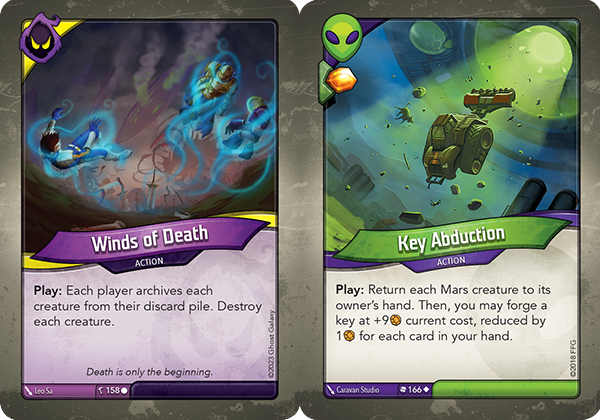
This was probably the most successful deck type to come out of Grim Reminders. The combo itself is quite simple: you cycle through your deck quickly, play Winds of Death, and archive all of your creatures—usually ten or more. Then, on the next turn, you take your archive, play Key Abduction, and get a free key. Just two cards, one is common, the other is uncommon.
If you have multiple copies of Key Abduction, or a way to archive it (often through Target Yynxzdyl), you can repeat this process over and over. At that point, there is almost nothing your opponent can do to stop you—except try to win faster, which was the only available option at the time.
Every Windka deck you saw at events was basically the same concept, just with different way of speed up the deck. Winds of Death is an absurd card in terms of design, and it works far too well with key cheats. Key Abduction had never been a real problem before, but suddenly it became the center of public outcry, with people demanding that it be changed to “purge after play.”
I am convinced that Windka was the single biggest reason people quit Keyforge during that period. And I share some of that guilt myself. During my competitive years, I played these decks to win—and in doing so, I gave many opponents a terrible play experience.
I do not think I will ever fully forgive myself for that, as long as I keep playing Keyforge.
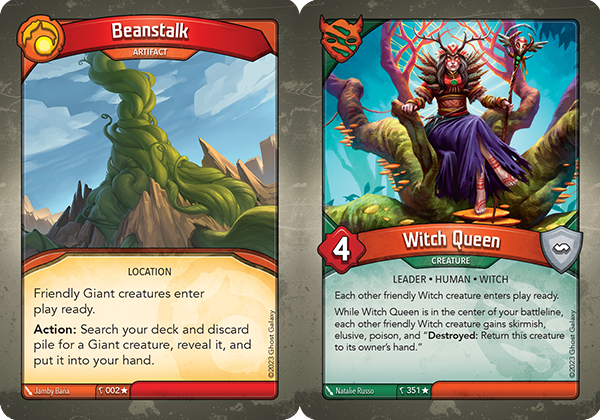
Honorary mentions in Grim Reminders go to Beanstalk and Witch Queen. Interestingly, they were about as strong as Hallafest, but compared to the three cases above, they were never truly a problem.
I could also mention interactions like Future Is Past into pre-nerf Ecto, which was also a terrible experience in sealed.
Arise Lockdown

Æmber Skies came after Grim Reminders and worked quite well as a counterweight to it. Overall, it was fun. But even though I like AS a lot, it still introduced NPE cards that I have to talk about.
The first one is Arise.
Arise is a single card that can swing an enormous amount of value, depending mostly on how good your creatures are—usually Dis creatures. It had only existed in one set before, the very first set, and back then you did not see complaint about it. There are a few reasons for that.
First, Dis creatures in the first set were not very strong, and on average you only brought back around four creatures. Æmber Skies is very different. It introduced many solid Dis creatures. For example, you now have threatening lockdown effects like Vapor Imp or Suspenmander, and instant disruption like Trihard.
On top of that, Æmber Skies introduced the house enhance mechanic. This makes your deck much more likely to have a large number of creatures to bring back with Arise. So your opponent needs a lot of creature control to deal with them—but then there is also recursion, and there is also disruption that can cancel those creature control cards.
These decks are not as extreme as the NPE cases from Grim Reminders, but they are still NPE. It feels like an unavoidable future: your opponent cannot do much to stop it, and once it happens, you lose because you are completely locked out of the game. They are rarer than the Grim Reminders NPE decks, but there are still enough of them to terrorize the game—like Vi (the deck I won KFC Open with in 2024) or Tutenkharnage Somneri. There are a few more, but they all shared the same short-lived fate once PV arrived.
This is also a much harder case to fix than Grim Reminders. In Grim Reminders, you could fix the problem by directly nerfing the key cards, and things would improve. Arise is different. Its effect is actually very reasonable on its own. It only becomes broken because of the surrounding card pool and the house enhance system. That means the only real way to fix it would be to change the card pool—which is impossible if you want to “fix” the set itself.
If you think about it, there is a reason why Fantasy Flight Games never reprinted Arise. Instead, they made a similar but much less potent card: Grim Reminder. During the FFG era, I even wrote an article in Vietnamese about how Arise limited their design space, while Grim Reminder expanded it. FFG was right to move to Grim Reminder, because it allowed them to design Dis creatures more freely.
I had forgotten about that article—until Ghost Galaxy reprinted Arise, and every terrible scenario I had imagined happened exactly as I feared in Æmber Skies.
Corner the Market with house enhance

This was another rare but short-lived case that most people would quickly forget. But for anyone who encountered it during that brief window, you know exactly how terrible it was.
It was essentially Corner the Market combined with Geistoid house enhance, where you could play it and then immediately get it back into your archive with In Here Somewhere in the same turn. After that, you could keep replaying it over and over, preventing your opponent from meaningfully playing the game.
Once this loop started, your opponent needed either a large board they could already use, or enough æmber to win without playing any cards at all. Otherwise, it became an unavoidable game state.
And people really hated it. Everyone who ever ran into this interaction will tell you how awful it felt. So even though it was rare, I still have to mention it.
There are still a few other cases in Æmber Skies, but in short, they all come down to two things: Mars Ro6 or recursion. In the end, they are just different shells of the same problems we already saw in Grim Reminders.
I will not talk about sub-sets like ToC or VM, even though there are also NPE cases there. In the end, they are still sub-sets. That means they are rare, and they never really succeeded in a competitive environment.
Now we finally get to PV.
This is probably the set with the highest amount of NPE you can point to. It was clearly designed as a high-disruption set. But the execution is so poor that I do not even need to go into detail here.
Prophecy

Here, I want to talk about the entire prophecy mechanic.
To be honest, I like prophecy as a mechanic—or more precisely, I like the idea behind it. And compared to other NPE cases on this list, it is not the worst one. But it still needs to be mentioned.
The problem is how prophecy effectively gives almost every deck a built-in filtering engine. It makes you question whether efficiency differences between decks even matter anymore. You will hear people say that GR decks, or MM decks, or whatever, are “faster.” But that does not really make sense, because those speeds are determined by what happens inside the 36 cards of your deck. Prophecy is an extra four cards.
Saying PV decks are faster is basically admitting that PV is unbalanced by design, because it has 40 cards instead of 36—and worse, those four cards will never brick your deck, and you always have access to them.
I consider this an NPE for several reasons.
First, in PV vs. PV games, the deck with the worse prophecy will always feel bad to play. You constantly feel: “I wish I had a better prophecies” because you are only playing two cards a turn while your opponent plays twice that. The same thing happens when a non-PV deck plays against a PV deck.
Second, it creates a long-term habit where, in future sets, you will always wish they also had prophecy so your deck does not feel slow. Why should you be stuck with normal draws when you could just play PV and filter your hand with prophecy?
I doubt Ghost Galaxy will ever see this as an NPE or as a design flaw. But in my view, it is—and it always will be—an NPE.
Atrocity

Atrocity will always be at the top of the list whenever people talk about PV.
As I already said in my previous article, it is a card that is both so powerful that it can win games on its own, and at the same time can do absolutely nothing. With some luck, you can lock your opponent out of the game for multiple turns at almost any stage of the match. With bad luck, it has zero value and your opponent clears it while having their most optimal turn.
Either way, one of the players will be frustrated—and sometimes both. It is the purest form of NPE. If you opened a dictionary and looked up “Negative Play Experience,” you would find Atrocity there.
It was so bad that Ghost Galaxy eventually had to step in and errata it, completely changing it into something that now provides almost no value. They released three errata in total, and none of them was nerfed as hard as this.
Years from now, we will still look back at Atrocity as a lesson in how NPE should never be designed.
Cosmic Recompense

We have had true “time-walk” effects since Grim Reminders, and even before that we had pseudo–time-walk effects in the form of house manipulation. But they only became a real problem in PV.
The reason is that all previous versions had meaningful downsides—either they gave your opponent something in return (actual recompense), or they could only be used once. Cosmic Recompense is different. It can be used multiple times in a single game. On top of that, there is recursion in PV, and you can also use Cosmic Recompense during another house’s turn.
Skipping your opponent’s turn is already bad enough. Being able to do it repeatedly is much worse. Who wants to play a game where the core experience is not being allowed to play? Very fun, right.
Ghost Galaxy errata’d it, but the errata addresses none of the problems I described above. So do not expect it to become a better play experience.
Trenk’s Creed

We have seen many powerful cards over the years that made people raise their eyebrows when they were first revealed. Trenk’s Creed is different. People did not just question how strong it was—they questioned whether it was even real, or whether its wording was a mistake. That alone shows how absurd its effect is.
It is a single card with one of the strongest swing effects in the game: it can potentially steal all of your opponent’s æmber, no matter how much they have. Indirectly, it also warps how the game is played by forcing opponents not to commit too much to the board. Playing against Trenk’s Creed feels similar to playing against Quixxle Stone—but arguably worse.
You cannot realistically play around it in sealed. So if your opponent happens to open it, the experience is simply terrible. In fact, if you play sealed and have Sanctum in your deck, there is a high chance you also have Trenk’s Creed, because Sanctum without it is so weak compared to other houses like Logos, Dis, Shadows, or Saurian.
The fact that you see Trenk’s Creed everywhere in PV events proves how dominant it is. And why Ghost Galaxy has not errata’d it will always haunt our minds.
Trust Your Feeling / Ask Again Later (and/or with random disruption)
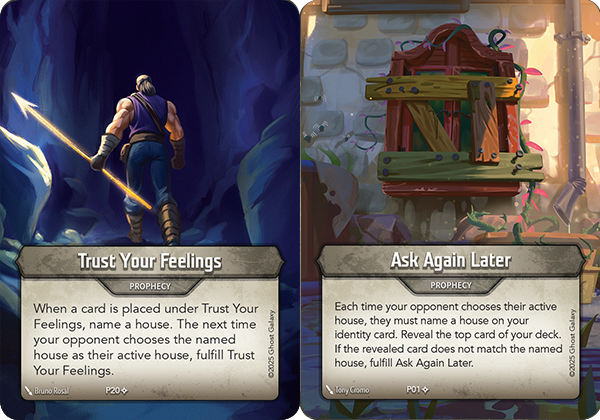
I already talked about prophecy as a mechanic above. Now I want to focus on specific prophecies—Trust Your Feeling and Ask Again Later.
To be honest, these two prophecies are not inherently broken. They are kind of fine on their own. The prophecy mechanic was clearly designed for disruption, which already leans toward NPE by nature. Many other card games also have interruption effects, and if you think about it that way, maybe I should not even list them here.
But I still have to, because of how often this happens. At Worlds 2025, I played four games:– In two of my wins, my opponent could not do anything for four turns straight.– In one of my losses, I could not do anything for the first three turns. All those games didn't last more than 7 turns.
I believe many players will find their PV games look very similar to this. And that is just how PV plays. If that is not unfun, then I do not know what is.
The reason I group this under TYF/AAL is because their timing is especially punishing. The disruption triggers after you call a house. So if a disruptive effect hits you, you cannot take that decision back—and in most cases, you simply lose a turn. A disruption effect at another timing might lead to a similar result, but this timing feels much worse.
On top of that, there is the layered randomness that Ghost Galaxy designed into PV: cards like Rage Reset, Strategist Feint, Reiteration, or Gleaming the Cube all have solid play effects, but their fate effects are overpowered and excessively random.
Ghost Galaxy decided to errata Ask Again Later by moving its timing to the start of the turn. Yes, that makes it slightly less bad—but the difference is barely noticeable.
So in isolation, prophecies like AAL and TYF are not the real problem. Random disruption on its own is also not necessarily the problem—it is disruption, after all. The real issue is overtuning their power, printing too many of them, making them overly random, and then pairing them with these prophecies. Together, they make the game feel miserable.
I once joked that you could print a card that gains 6 æmber, forges a key for free, clears the board, and archives two cards from your discard pile—and it would still have a 50/50 win rate against PV, because you might never get to play it.
It was a joke. But these days, it does not even sound like one anymore.
PV actually has many more cards that make you question what just happened when you see them in a game. Most of them are simply overpowered—cards like Hoodwink, Cryptic Collapse, Feldar’s Plan, Cover Fire, or Exotic Pivot.
But I would not put them on this list, because they are not truly NPE in the current state of the game. They are mostly just examples of power creep. Power creep can sometimes create NPE, but very often it does not.
The frustration they cause usually comes from the fact that we have never had so many cards at this power level before. They are still bad. They are still weird and often unreasonable. But they belong to a different discussion entirely.
FINAL WORDS
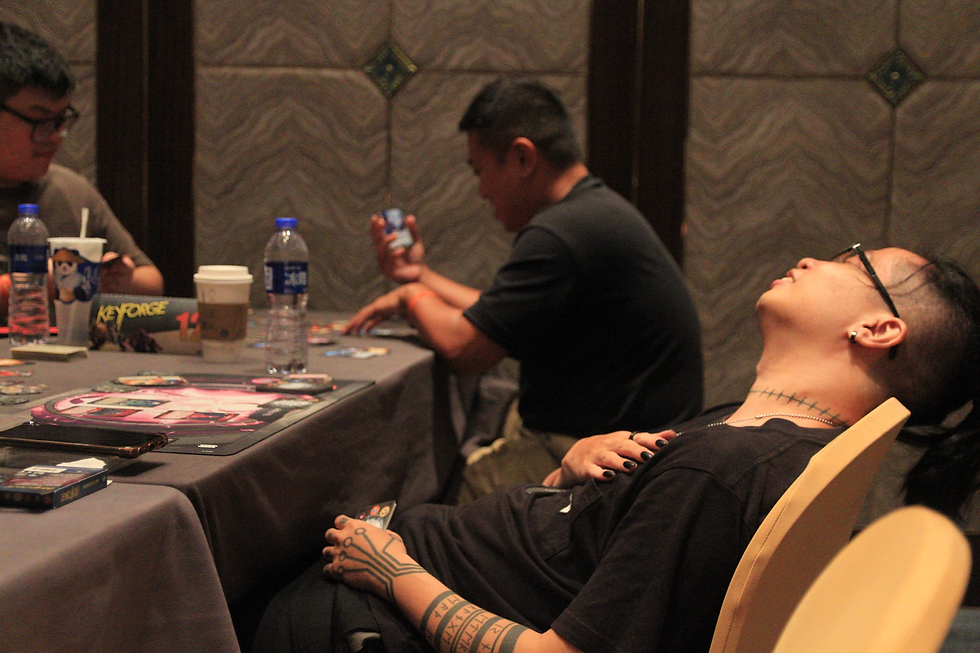
It is strange to see that NPE has become more and more common in Keyforge. It was very rare during the Fantasy Flight Games era. Of course, if you go back far enough, you can still find complaints here and there—but they were not nearly as bad as what we see now. Back then, you did not see people quitting the game outright just because of a few bad experiences. We do now.
I would even say that having your collection become irrelevant within a few months is also one of the worst forms of NPE. So despite Ghost Galaxy claiming that their goal is to make the game fun, I feel the result has been the opposite. Over the span of just three years, we have seen an enormous amount of NPE. I am speaking from my own experience, and I believe many people share the same feeling.
Feelings like:
Why am I even here if I cannot play?
This does not require skill, yet they win?
My collection is garbage now—why should I invest in it?
Why am I playing this game just to watch my opponent play for fifteen minutes?
When Grim Reminders was released, we felt terrible. We truly believed the future would become brighter with Æmber Skies. AS had many flaws, but it was the first decent set we had in a long time, so we liked it. Unfortunately, that did not last. Then PV arrived, and we started asking ourselves how it was even possible to make something worse than Grim Reminders.
I am writing this article only to talk about NPE. I am not going to end it with predictions about the future or propose solutions. I have already talked about those in other articles.
So this will be the end.
I can only hope that we will see less NPE in the future—though, honestly, the outlook is grim.
If you wish to discuss this topic further with me, feel free to join my Discord:https://discord.gg/mGhBmuhbcv


Comments