
MAKE KEYFORGE GREAT AGAIN: GRIM REMINDERS
- Nguyễn Rikun
- Dec 21, 2025
- 18 min read

And I am back.
Last time, I discussed Prophetic Visions—the lowest of the low. I genuinely believed that PV was the worst outcome we could possibly get, and that nothing afterward could sink the game any further. That said, Ghost Galaxy’s design track record has a way of surprising us, so who knows.
However, the downfall of KeyForge design did not begin with Prophetic Visions.
I could go into detail about the past, and to be clear: not all earlier sets were good. Some were below average. Some had clear design flaws or balance issues. Call of the Archons, despite being a successful launch, was scattered in its design, required multiple errata, and—when revisited today—shows a very uneven distribution of card quality. Age of Ascension failed to excite as a second set; while it contained many hidden gems, the sealed experience felt bland. Worlds Collide struggled with arguably the weakest house in KeyForge history while simultaneously introducing two of the strongest houses ever printed under FFG. Dark Tidings was strong in concept but poorly executed, and it had persistent difficulty finding a stable place on the competitive power scale.
Yet all of those sets remained acceptable within the bounds of reasonable balance. At worst, they failed to compete at the highest levels of play—and that was it. The game was still fun. You could still see top-tier decks emerging from every set.

By contrast, while every set produced by Ghost Galaxy has shown more severe flaws than even the weakest FFG-era releases, the real turning point begins with Grim Reminders.
Grim Reminders was the first set designed entirely by Ghost Galaxy. And if you remember—even just a year ago—it was everywhere. Complaints flooded every platform imaginable. The backlash was louder than what we see today with Prophetic Visions. In fact, if PV feels less criticized now, it is not because it is better, but because Grim Reminders exhausted the community. People became tired of complaining. Many simply quit. Others continued playing not out of enjoyment, but out of habit.
I believe Grim Reminders is the root cause that led directly to Prophetic Visions. Instead of addressing the core problems head-on, Ghost Galaxy chose a different path—one that ultimately compounded those issues rather than resolved them.
I will return to that point later. But first, let me tell you a story.
THE LEGEND OF NGHI
Bamboo—my wife, and the 2024 Archon World Champion—started playing KeyForge when Winds of Exchange was first localized in Vietnam. She came from a strong competitive gaming background, but in KeyForge she was merely solid for quite some time, unable to consistently break through the top tier.
Grim Reminders released in Vietnam around early 2024. Not long after that, Bamboo opened Nghị—the deck she would later win Worlds with, and the deck that I terrorized the NKFL scene throughout the year. It is a Grim Reminders deck, featuring what is arguably the strongest Geistoid ever printed. There may be two or three Geistoid decks that are technically stronger on paper, but none of them achieved the level of dominance or consistency that Nghị did.

The deck has an absurdly low creature count in-house—three creatures, two of which are effective—paired with seven actions (essentially the best possible seven) and two artifacts, one of them being the infamous Well of Memory. The game plan is brutally simple and brutally effective: abuse Well of Memory and Return to Rubble to loop Geistoid actions every turn, generate massive amounts of æmber, and then key cheat at the correct moment.
It is incredibly consistent. It is incredibly fast. On average, it wins on turn six. At the time, I exaggerated and told people it could win in four turns—and they still believed it, because Nghị occasionally won in three, and people had seen it happen.
What made it unbearable was that there was almost no meaningful interaction available. Every game against Nghị became the same miserable experience: you sit there while Bamboo plays ten or more cards in a turn; then you take your turn, play two or three cards, and pass; then you watch her do it again. You cannot disrupt it. You cannot race it. You cannot meaningfully respond.
I consider myself to have very strong game-reading skills. I am confident that I can usually see three to four turns ahead and accurately infer what my opponent is holding. During the Grim Reminders era, that skill felt like a curse. I could clearly see my inevitable loss several turns in advance—and worse, I knew that loss would be stretched out over ten minutes of watching my opponent play solitaire while I did nothing.
That was my experience playing against Bamboo with Nghị. And it was the experience of every Vietnamese player who had to face it during that period.
We had powerful decks before. Even the strongest deck at the time—my Genka deck, Leftculum—still gave you the feeling that you might win if you played well. Nghị was different. Against Nghị, you felt hopeless. There was no deck you could bring that truly matched it.
To make matters worse, Nghị’s æmber control actually improved when the opponent played creatures—which is, of course, the core gameplay loop of KeyForge itself. That design interaction was devastating.
It was a terrible time. Faced with Nghị and several other Grim Reminders decks, many players simply quit the game. After a single event—Store Championship 2024—I lost half of my local player base.
That kind of deck is fundamentally toxic to the game. While it is unavoidable that algorithmic generation will occasionally produce powerful outliers, decks like Nghị go far beyond that. They introduce a solitaire playstyle that is unfun for everyone involved—especially the opponent. Nobody queues up for a game in order to watch someone else play.
Extended exposure to Nghị also had a more subtle, but equally damaging effect. Playing that deck for a long time caused Bamboo to bypass many of the fundamental skills of KeyForge. When she picked up other decks, she struggled in situations that required thinking outside of Nghị’s narrow game plan. To be honest, this pattern extended to many players who started during the Grim Reminders era as well. When I played against them, I noticed frequent beginner-level mistakes—errors in sequencing, threat assessment, and tempo management. Yet because their Grim Reminders decks were strong, they developed a sense of confidence that was not supported by transferable skill.
This was also the period when average players loudly praised Grim Reminders, claiming that “this set is great because it helps new players catch up with veterans.” That narrative was a lie. I explained this in my previous blog, but the outcome is clear: over the past few years, almost no new players have achieved meaningful competitive results.
To be fair, this phenomenon did not occur everywhere. Truly top-end Grim Reminders decks are rarer than they appear. But they existed—and where they did, they distorted entire local scenes. In the United States, there was Bandola, followed later by Boxsmack. In France, Dictateur. And then there was Pastor Ass, arguably the strongest Grim Reminders deck ever printed.
This is how Ghost Galaxy normalized the worst playstyle imaginable—not just for KeyForge, but for card games as a whole: solitaire.
Enough bad talk about my wife—I still want to sleep soundly tonight.
Jokes aside, the point here was never about Bamboo, Nghị, or any individual player. They are symptoms, not the disease. What matters is what Grim Reminders revealed about Ghost Galaxy’s approach to design, and how that approach set the direction for everything that followed.
So let’s move on to the real issue.
WHAT WENT WRONG WITH GRIM REMINDERS
At a fundamental level, I believe Grim Reminders is worse in design than Prophetic Visions—and worse than anything Ghost Galaxy has produced to date.
My read is simple: Ghost Galaxy was riding high after the success of the Winds of Exchange Gamefound campaign. It was their first full set, their moment to prove themselves—and they went all in. Too far in.
They printed a large number of cards that look incredible on paper: extremely high power ceilings, pushed efficiency, and flashy effects. The problem is not that these cards are strong. The problem is that there was no meaningful answers to them. That is the core failure of Grim Reminders: power without counterplay.

This problem concentrates heavily around two mechanics that previously had very limited interaction: archive and key cheating. These are not new mechanics—but they are extremely delicate ones. Even during the FFG era, you can see how cautiously they were handled. Archive and key cheat appeared rarely, and when they did, they were tightly constrained.
FFG’s designers clearly understood how sensitive these mechanics are. They knew that once you allow players to stockpile perfect hands or bypass the core pacing system of the game, the entire structure of interaction begins to collapse. Grim Reminders ignored that lesson.
Instead of careful exploration, Ghost Galaxy pushed both mechanics aggressively—without first ensuring that the ecosystem had the tools to respond. Once that door was opened, the consequences were inevitable.
KEY CHEAT

Let’s start with key cheating.
KeyForge introduces a win condition that follows a very strict, step-by-step structure. In many other card games, you can win during the play phase. KeyForge is different. You must wait until the start of your next turn to forge a key—and you can only forge one key per turn. This gives the opponent a guaranteed chance to respond. That system is fair, skill-testing, and well designed.
Key cheat itself is not new. It has existed since the first set and appears in every set. However, during the FFG era, key cheat was rare and difficult to pull. FFG designed Untamed as the house most likely to access key cheat, giving it the easiest key-cheat tools along with strong æmber generation to support them. This fit the house identity well: play creatures, fight for the board, fight for æmber—while still leaving plenty of room for the opponent to respond.
Other key-cheat effects existed across different houses, but they were rare and required planning and synergy to execute. Some people argue that GenKA was the worst case of key cheat during the FFG era. I disagree. Only a very small number of GenKA decks actually worked. Most required high skill to pilot, and even when they did work, there were many ways to play around them. Most importantly, no GenKA deck ever dominated the competitive scene. That alone proves that key cheat, as handled by FFG, stayed within reasonable limits.
That is how key cheat functioned in KeyForge. It already went against the core concept of the game, so you did not want to make it stronger or more convenient. Once key cheat removes counterplay, skill expression drops and frustration rises. It is a very delicate mechanic.
Ghost Galaxy chose to mess with it anyway.
Grim Reminders was the first set to introduce key cheat in every house (Ekwidon has a pseudo key cheat, but it still counts). Most of these key cheats were fully supported by other cards within the same house. Key cheat became common. You saw it everywhere. You could reasonably say that a large portion of Grim Reminders games were decided by key cheat alone.
This was completely different from the FFG era. There was almost no counterplay.
The fact that Ghost Galaxy later added “purge this after forging” to key-cheat cards proves that they realized how bad the problem was. In my opinion, that solution is lazy and poorly thought out. I would rather have repeatable key cheat that both players must play around than easy, one-time key cheat. The latter effectively lets one player play a two-key game instead of a three-key game.
ARCHIVE

Archive is another innovative mechanic in KeyForge. It allows you to keep cards outside of your hand, like a side deck, but it requires card effects to do so and has restrictions on when you can take those cards back. It is interesting because there are many ways to take advantage of it.
You can keep cards for later use—either to pull them out next turn for tempo, or to hold situational cards for specific scenarios. You can also use archive to filter and thin your deck, so you do not draw into certain cards after a shuffle. Managing archive properly is important: you want to organize it so that when you take it back, it does not damage your future turns.
There are many small details around archive. During the FFG era, there were also limited ways to archive cards, except in Logos, where it was part of the house identity. House identity matters. Because of that, there were also limited ways to interact with an opponent’s archive. Even though it could feel awkward when facing a deck with many archive effects, archive was rarely a real problem before.
We could talk more about how archive was almost untouchable during the FFG era, and whether Logos itself was unhealthy for the game, but that is a separate topic.
The important point is that archive, like key cheat, always allowed both players to play around it.
In Grim Reminders, however, archive became far too easy. The number of cards you could archive was so absurd that it offered little to no counterplay for the opponent. Archiving an entire deck became common, something that almost every Grim Reminders deck with Geistoid could do.
Naturally, this became a serious problem. At that point, the game had almost no tools to interact with archive. Once again, a delicate mechanic was pushed too far, with no counterplay, encouraging a solitaire playstyle.
Right now, I could share some thoughts about how I would remake the set, or how I would fix it if a remake were not possible. Since Ghost Galaxy has also tried to resolve these problems in some ways, I will talk about those together later in this post.
For now, it is better to continue discussing what went wrong with Grim Reminders first.
GEISTOID

Of course, we have to start with Geistoid.
This is the first house that Ghost Galaxy created entirely on their own, since Ekwidon is believed to have been designed by FFG. Somehow, the fact that a whole house needs to be discussed here is already ironic—because in my opinion, the entire Geistoid house is broken.
We have had powerful houses before. In every set, there are houses that are clearly stronger than others. We have examples like Saurian in Worlds Collide, which was famously stronger than anything we had seen during the FFG era. But none of those were like Geistoid in Grim Reminders.
The theme of Geistoid is abandoned, ghostly machines, and its identity is a house that plays around the discard pile. I believe Ghost Galaxy wanted the house to move through its deck quickly, then dig back specific cards to replay them. That idea actually sounds reasonable and quite unique, since no other house had a similar identity. We already had cards interacting with the discard pile before—some of them were quite solid, like Exhume, which plays a creature from your discard pile. So this direction made sense.
Then Ghost Galaxy overtuned the house.
Geistoid has many ways to go through its deck extremely fast (Boo!, Hallowed Eve Festival, In Here Somewhere), filter cards in hand while doing so (Junk Restoration), archive specific cards from the discard pile to replay later (In Here Somewhere), and repeat this process again and again. Notice that I am only mentioning common cards. Yes—all of these are commons, and all of them have an æmber pip. That means these very powerful tools appear easily and consistently in most Geistoid decks.
On top of that, with additional synergy tools at higher rarities, the house also has disruption, æmber control, creature control, and artifact destruction. Everything is packed into a single house—and you can keep replaying those effects while also gaining æmber.
That is the core problem.
In the past, a good card usually did one thing well—maybe two. That was it. No single house gave you everything you needed to play the game, because that is the foundation of KeyForge. Your deck has three houses, and you are meant to play all of them, explore your deck, and enjoy the interaction. If you want to stop your opponent from forging, you call Shadows or Dis. If you want to speed through your deck, you call Logos or Star Alliance. If you want to build a board, you call Brobnar, Saurian, or Sanctum.
That division of roles is fundamental to KeyForge.
Grim Reminders Geistoid breaks that rule. You can call Geistoid and do five different things in a single turn. It goes directly against the core concept of KeyForge as it existed before.
SOLUTION TO THE PROBLEM
There are many individual cards we could go into in detail. But instead, let’s look at what actually happened to “fix” Grim Reminders.
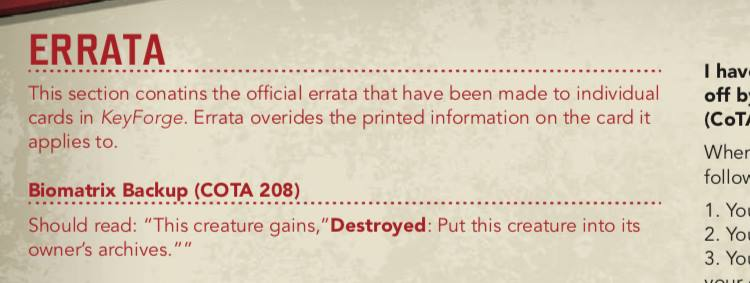
Ghost Galaxy decided to do almost nothing about it (outside of a single errata). I understand why this was considered a viable option. Any kind of direct fix would have cost a lot of resources—money, time, or both—and no matter what they did, they would still face backlash from the community. So they chose to ignore the problem and instead focused on designing future sets with answers to Grim Reminders.
In other words, all future sets would include tools to counter archive and key cheat in some way.
I do not agree with this decision. By doing this, future sets are not only countering Grim Reminders, but also countering everything before and after it—limiting mechanics that were previously fine. By keeping Grim Reminders unchanged, Ghost Galaxy also raised the power bar so high that future design now has to keep pushing upward, leaving very little room to work with in just a few years. Prophetic Visions is the inevitable result of that decision—unless, of course, Ghost Galaxy has no long-term plan for the game beyond the next few years.
That said, with this approach, the problem was temporarily fixed.
Aember Skies (and Tokens of Change) introduced cards that could destroy archive. These sets are, of course, more powerful than older sets, and they have their own flaws. But for a short time, they made the game feel better. They were, in some ways, more fun to play than Grim Reminders.
Just for a short time, though.
If you pick some random, average Geistoid decks and play them, the game actually feels much better. That is probably because those decks either do not have strong Geistoid cards, or their Geistoid package is only average, or they simply do not have any solitaire shenanigans. This shows that the set itself is actually fine if you can bring the ceiling down.
So, if we were to remake the set, my opinion is that we should do two things:
Remove all key cheat.
Remove almost all æmber pips from Geistoid cards.
By doing just these two things, I believe the set would become much healthier.
For Geistoid, it would become very clear that the house is still fast, still has a lot of recursion, and can still do many things—but you would no longer gain æmber just by playing Geistoid cards. This would force players to treat Geistoid turns as support turns for their other houses, rather than a complete win condition by themselves.
Removing all key cheat from Grim Reminders would also make the set significantly healthier. You could still pull off high-tempo combinations, like that stupid Ro6 Mars turn, Witch Queen lines, or WoD into your whole deck. But at the very least, you would not be able to win immediately after those plays. You would be left vulnerable to interaction, including scaling æmber control.
Most importantly, it would restore counterplay.
INDIVIDUAL CARDS THAT CAUSE TROUBLE
If we want the set to be even better, then we can also fix a few individual cards.

This card is at the top of the list in terms of power. However, the fact that it is a Revenant—meaning it is extremely rare—changes how we should look at it. If you remove key cheat and æmber pips from Geistoid, this card actually becomes quite acceptable.
It is still obviously over-the-top powerful. But given how rare it is, that level of power can be justified for excitement. Even as a competitive player, I agree that not everything needs to be judged purely from a competitive standpoint. It is fine to allow some extreme moments to exist.
Without key cheat, you can still play around this card.
The fact that, even during Grim Reminders last year, there were zero Ruth decks winning events also supports this point. At that rarity level, the power is acceptable.
So my verdict is simple: let it be, and let a few people have some fun with it.

The prize for winning the World Championship in 2024 was the opportunity to design a card for the next set. Because Bamboo does not speak English well enough, I had the chance to work directly with the head designer of KeyForge.
During that discussion, they seemed very clear about how powerful ready effects are, how harmful they can be to the game, and how they need to be limited. That is why I am very confused when I keep seeing over-the-top ready effects appearing everywhere in every set after that conversation.
These cards here is a good example of how something that looks acceptable on the surface becomes a real problem in practice.
It is a ready effect that can directly lead into another ready effect. That means you can easily go out of control by simply having two cards. And if you add more cards that synergize with it, you can imagine how bad it gets.
In the past, we had a few ready-effect cards. Only maybe three of them could lead into another ready effect, and all of them had clear downsides—such as requiring an empty opponent board, or not being printed at common rarity. Here, both Dr. Xylo and Ironyx Rebel are common.
I think Ghost Galaxy’s direction for Mars is clearly focused on ready effects, since that has been Mars’s identity in every set they have made. That direction could be fine. But Dr. Xylo is still over the top. In Aember Skies, they removed Ironyx Rebel from the pool, and while there are still some dumb combinations, the game feels more acceptable as a result.
So, without key cheat in the set, I think this combo can be okay-ish. However, for future designs as well, Dr. Xylo should be errata’d to remove the “and ready it” part of its effect. That change alone would make the card much more reasonable—still powerful, but no longer capable of leading into another potentially broken chaining sequence.
We are not playing Yu-Gi-Oh, you see.

Again, these cards are strong. But if there is no key cheat, and Geistoid no longer provides a huge amount of æmber pips, then these two cards are fine. You can still get all of these cards back and replay a large number of them in a single turn, but without gaining æmber, your plan becomes preparation for future turns.
That means your opponent can respond.
These cards might still need some adjustment, since my suggestions would also require playtesting. But for now, I think they are fine.

Again, ready effects.
You actually did not see many of these succeed in events last year. There was only one rare case involving Witch Queen, which was Bandola. Because of that, these cards are actually kind of fine. At this point, the list is already reaching into the category of cards that would only need fixing to improve the casual play experience.
Also, if Geistoid becomes weaker, I am quite sure Beanstalk would become a very solid presence, while Witch Queen would still remain rare.
But can you imagine cards like these existing during the FFG era? Cards that ready everything with no downside? The closest thing we ever had was Cincinnatus Rex, which exalted itself many times and still could not pull off its effect immediately without support.
If you put Beanstalk into Worlds Collide Brobnar, this card alone could change the entire house—from a bad house into one that actually works. Of course, it is rare, but now Brobnar decks can potentially become over-the-top powerful.
I do have a few thoughts on how to address this. One possible fix would be to change it so that only the first Giant creature enters play ready.
As for Witch Queen, we can simply leave it as it is. Unlike Beanstalk, Witch Queen is not powerful on its own.

The last card I will talk about is the famous Winds of Death.
You have probably heard about this card being a problem more than anything else, mainly because the ability to archive all your creatures is extremely powerful. Before Ghost Galaxy, it was quite rare for a player to have their entire deck in hand. There were a few top decks that could consistently reach around fifteen cards, and from that point they would usually win, simply because the card advantage was so high.
After Ghost Galaxy, Winds of Exchange introduced more ways to draw cards. But with Winds of Death—together with other Geistoid cards—suddenly having your whole deck available to play became a normal thing.
I still think that if you remove all key cheat, Winds of Death would be kind of fine. It would still be strong, of course, but it would return to being a tempo and card-advantage play, and the opponent could respond by saving board clears.
If we do need to fix it, though, one possible solution would be to archive only opponent creatures. That would be a reasonable middle ground. It would change the concept of the card entirely, but if we are fixing it, we need to decide what we actually want the card to be. Do we want it to be a combo enabler, or do we want it to be a board clear? It should not be both, because both effects are very powerful.
We had a similar card before: Final Analysis. But while Final Analysis also allows the player to choose when to play it, drawing cards is much weaker than archiving them. On top of that, the draw is limited by the number of creatures you control, which is a very well-designed restriction. Winds of Death is simply powerful with no real limit.
FINAL WORDS

I could talk more—there are more problematic cards. But I think this is enough for now. These are already a lot of changes, and all of my suggestions would still need proper playtesting. At the very least, I feel this is a good starting point.
In my opinion, Ghost Galaxy does not spend enough effort on design. I do not consider myself a competent designer, and I have always been a trial-and-error type. I try different options, reflect on the results, and then improve. It does not feel like Ghost Galaxy spends enough time reflecting.
I wonder if this is simply because of how many sets they had to design in such a short time. From 2023 to 2024, they released nine competitively legal sets and two extra “fun” sets. That is a massive output. It leaves very little time to actually design, playtest, reflect on what went wrong, and improve. We keep seeing the same design flaws repeated, which strongly suggests that lessons are not being learned. And the way they chose to deal with problems—by printing direct counter-sets—is, in my view, a very lazy solution.
This year, they released far fewer sets, which I think is a good thing. However, hearing that they are also working on two new card games worries me. Instead of making fewer sets, they are now making more games. It feels like they are putting too much on their plate, while having fewer resources than they think they have.
I am not a successful figure in this business like CTP, so I may be wrong. But I genuinely wonder why they are rushing so fast. There is plenty of time. Quality is what they should be focusing on. There are many possible explanations, and we will probably never know the full story.
What we do know is that the damage from Grim Reminders and Prophetic Visions is already done, and it is very hard to reverse. It is difficult to imagine a new set that can compete with Prophetic Visions without pushing the value of individual cards two steps higher. And now, every new set has to include archive control, otherwise it cannot even compete with Grim Reminders.
At this point, we all understand the lesson: when you give yourself too much freedom early in design, you leave yourself with very little room for creativity later.
And that is why I believe Grim Reminders is the worst-designed set Ghost Galaxy has produced, and how it became the beginning of everything that followed.
If you wish to discuss this topic further with me, feel free to join my Discord:https://discord.gg/mGhBmuhbcv


Comments