
MAKE KEYFORGE GREAT AGAIN: PROPHETIC VISIONS
- Nguyễn Rikun
- Dec 15, 2025
- 14 min read


As many of you already know, I am playing less KeyForge now. Ironically, that has given me more time to write. I used to enjoy writing, and I have realized that I still do—especially when it comes to these wall-of-text blog posts.
Lately, I have been thinking about a simple but uncomfortable question: given our current situation, how could KeyForge actually become better?
We have been through a lot. There is no clear or consistent local OP structure. Player numbers are visibly declining. And, bluntly, we have received several badly designed sets. If you do not already know, I—and a very vocal part of the community—have talked extensively about how problematic Grim Reminders and Prophetic Visions are.
Maybe we are making a bigger deal out of this than necessary. But the data points are hard to ignore. Player numbers are dropping. I have personally watched people stop playing the game because the experience simply became bad. And the harsh truth is this: many of these players loved KeyForge deeply. But once they stopped, they found no compelling reason to come back.
After everything, I have reached one conclusion: the community can endure almost anything as long as the game itself is good. Right now, it is not. Not even close.

MY PERSPECTIVE
I was part of the playtesting team up through Æmber Skies. I genuinely hoped I could contribute more, but for some reason, I didn't. I often felt disconnected from the rest of the playtesting process. Perhaps there was a Discord server or a discussion channel that I never found. Perhaps I missed an announcement. I only started wondering about these things after I had already stopped playtesting.
Part of the reason I stepped away was also personal. I wanted to experience Prophetic Visions fresh, without already knowing every card and entering with the same hyper-competitive mindset I had during Æmber Skies. I wanted to enjoy KeyForge again, to explore something new.
That plan did not work out.
The beginning of PV was genuinely fun. But the power level of the set was simply too high. Very quickly, I was dragged into an arms race. My old decks became invalid overnight, while my own PV decks still could not compete with stronger PV lists. I enjoyed the set conceptually, but the constant escalation felt miserable.
From that point onward, PV dominated everything.
There were only two major events where PV did not win:
Baltimore: PV was still new. I believe at that time, fewer decks had been opened, refined, and practiced. Many players still brought decks from other sets as well.
Vietnam: To be honest, the overall PV deck quality was not particularly high, and the competitive skill level here is not on par with stronger regions.
That was it. Everywhere else—including Worlds—PV was everywhere.
At this point, most people acknowledge that PV is a problem. During KFC, at Meet the Ghost, these concerns were raised directly to Ghost Galaxy’s head designer. The response was unsatisfying—something along the lines of: “I don't know, I am not a competitive player, but when I tried PV, I found it fun.”
Fun is undeniably important in design, but if a mechanic is only enjoyable for one or two games before becoming exhausting, then it fails to sustain the experience. But the more you play it, the less fun it becomes. And even if the set was designed primarily with casual play in mind, Ghost Galaxy cannot ignore the competitive ecosystem it actively supports through OP. Competitive players are not a side audience; they are foundational.
I do not pretend to know how to fully undo the damage that has already been done. Remaking the set entirely is one idea—but that would require serious crisis management, especially given the resources already invested by both the publisher and the players.
Still, if the set were to be remade, this article is about how it could be better.

Two Design Principles That Matter
Before diving into specifics, there are two fundamental design questions that must be addressed.
1. Balance Structure
I am not a TCG designer, but I did study game design for a year in Japan and worked as a game designer in Vietnam for another year. Most of my experience is in mobile games and smaller projects, not something on the scale of KeyForge. Still, one principle always applied: you define a balance structure before you design content.
Typically, you establish a point-based system. Each resource has a baseline value. In a mana-based card game, for example, one mana might equal a 1-health creature. An ability might be worth an additional 0.5 mana. You then define hard limits: perhaps the maximum value of any card is 5 points, and the average value across a set is 3 (Just an example, because Keyforge has no resource for play cards).
Over time, you may slowly raise these limits—5.2 max, 3.3 average. You need to do that, because it keep the game fresh and engaging. That is controlled power creep, spread across years, not a single release. You never jump from 5 to 10 in one set. Though I could debate that a game like Keyforge would ever need powercreep but it will be entirely another different topic in another different blog post.
This structure should also run parallel to rarity. You round card values into tiers—1 through 5—and control their distribution across a set. This prevents extreme power disparity between cards and houses. Weak cards and “filter” cards are necessary. Strong cards will always exist; the goal is to control how many and how strong they are.
Of course, this is only a simplified explanation of a point-based system. Many aspects of card games—especially randomness—cannot be cleanly reduced to fixed numbers. Still, I hope the idea is clear. A structure like this is valuable not only during design, but also during playtesting, because it gives playtesters a shared framework to evaluate whether a card’s power level is appropriate, or whether unexpected interactions are pushing it too far.
2. What Are We Trying to Achieve?
Every mechanic, every card, every concept must exist for a reason.
The clear goal of Prophetic Visions was to introduce out-of-turn interaction—something closer to a “take-that” mechanic. The idea is simple and reasonable: you do A, and now you are punished by B. Surprise, disruption, and tension.
That goal is valid. Everything I discuss next assumes we are keeping that intent.
Prophecy as a Mechanic
Prophecy—and its extension, fate effects—is the core of PV. When first revealed, the mechanic was well received. Even now, most complaints are not about the concept, but about execution.
There are 22 different prophecies, spread across multiple timing windows: start of turn, after choosing a house, during play, and end of turn.
Here is where things go wrong.
Overlap and Extreme Power Disparity
Many prophecies overlap heavily, yet vary wildly in power. This mirrors earlier issues like token design in Winds of Exchange and Tokens of Change. The intent is obvious: opening a deck should feel exciting. But the result is that one bad prophecy can cause players to discard an entire deck immediately. I am conflicted on this philosophically, but practically, the disparity is too large. So maybe we can find a middle ground somewhere.
Punishing Timing
Certain prophecy timings are extremely punishing—most notably those that trigger immediately after a house is chosen. Anyone who has experienced this knows how devastating disruption at that moment can be. Disruption is, by nature, meant to be impactful, but I would argue that a mechanic becomes problematic when it is both highly punishing and largely random.
For comparison, consider Flesh and Blood. In that game, cards can be used either offensively or defensively, and because card draw is limited, the timing of those decisions is critical. Choosing to commit cards to defense weakens your offence, sometimes leaving you with none at all. This creates a steep learning curve: a single poor decision can lead to several bad turns—or even lose you the game outright. That tension is one of FaB’s greatest strengths, but it is also why such mechanics must be handled with extreme care.
Punishing systems can work, but they are delicate. To illustrate why, I want to share a personal example.
I used to play Warhammer 40,000, and I loved it. I invested heavily in the game and genuinely enjoyed its gameplay, even though the rules are notoriously complex. I vividly remember my first match—one I had been excited about for a long time. I felt confident in my army and in my ability to approach the game with a fresh mindset.
I had positioned a vehicle carrying my elite unit, ready to break into my opponent’s battle line and cause real damage. What I overlooked, however, was a critical rule: units cannot disembark from a vehicle after it has charged, and they also cannot disembark if enemies are within a certain distance of that vehicle. It is a highly punishing rule and an easy one for a beginner to miss.
That single mistake effectively decided the game within the first few turns. More importantly, it killed my motivation to continue with the hobby. That is the effect punishing mechanics can have when they are too easy to stumble into, especially for newer players.
What makes this even worse is that KeyForge’s punishing mechanics are largely random. In Flesh and Blood or Warhammer, you can learn from your mistakes and improve over time; those rules are punishing, but they are also integral to what makes the games rewarding. With prophecy, however, there is nothing to learn. The outcome is random, and when it hits again, it is just as punishing as it was the first time.
When combined with certain fate effects and specific cards, this randomness creates a significant number of non-interactive game states—situations where one player simply has no meaningful response. These are exactly the kinds of scenarios a game like KeyForge should avoid.

Suggested Structural Changes
Based on these issues, I would propose the following changes:
1. Reduce the number of prophecies.
The total number of prophecies should be significantly lowered. This may also warrant revisiting the rule of four prophecies per deck—perhaps reducing it to two—but I will not go deep into that here. At the very least, overlapping prophecies where one is simply a strictly worse version of another should be removed entirely (yes, I am looking at Bad Omens).
2. Introduce rarity to prophecies.
Adding rarity would inevitably make certain prophecy combinations more common, but that is a reasonable tradeoff. Each deck still consists of 36 unique cards. More importantly, rarity allows designers to control power disparity between prophecies and to restrict how often certain types can stack within a single deck. Stronger prophecies could be in different rarity, and prophecies with different resolution timings should follow different rarity distributions.
3. Simplify prophecy timing.
Prophecy resolution should be limited to three timing windows: start of turn, during the play phase, and end of turn. The idea of triggering after a house is chosen is not inherently bad, but it requires a much more careful balance to avoid extremes—either doing nothing or completely crippling a turn. Alternatively, the current timing structure could be retained, but only if disruptive fate effects are meaningfully toned down (which I will address later).
4. Remove prophecy as a pure card-filtering engine.
It is clear that Ghost Galaxy intended prophecy to include an element of bluffing, which likely explains why decks contain four prophecies with so many different conditions. In practice, however, the ability to filter one card per turn is so powerful that bluffing is effectively irrelevant. I have played hundreds of PV games and have seen genuine bluffing occur exactly zero times.
When bluffing does arise, it usually collapses into one of two outcomes: either the opponent pushes through because the action is necessary regardless whether there is a bluff, or the opponent ignores it, at which point the loss of consistent card filtering makes the bluff meaningless. The design simply does not support bluffing in any meaningful way.
For that reason, I see little value in preserving bluff as a core element of the mechanic. One possible solution would be to introduce a downside when a prophecy is fulfilled but reveals no fate effect—for example, exhausting the prophecy so it cannot be used again until the following turn. Changes like this would help prevent PV from passively strengthening every deck simply by existing.
Problem Cards
Some cards deserve special attention.
ASK AGAIN LATER

lol I hate this card.
If you know me, you know that I rate AAL extremely highly—easily among the top two prophecies in the entire set. Acknowledging its power, however, is separate from liking its design, and I genuinely dislike it.
I value consistency. I want my turns—and my opponent’s next few turns—to be reasonably predictable and calculable. That is also why I have always disliked the token mechanic. AAL does the opposite: it introduces a random prophecy that can cascade into another random fate effect. If I wanted that level of randomness, I could just play Hearthstone.
But KeyForge is not Hearthstone. Hearthstone is a digital game designed to fully exploit randomness and automation. KeyForge has historically kept randomness to a minimum, which is part of what makes it engaging as a physical card game. Pushing randomness too far simply turns the experience into a chore—driving somewhere to sit down, roll dice, shuffle cards, and hope variance does not decide the game for you.
For these reasons, my recommendation is straightforward: AAL should be removed from the game entirely. It is the only prophecy whose condition is itself random, and its effect has already left a noticeable scar on the competitive scene. That alone should be reason enough.
TRENK'S CREED

Trenk’s Creed is a textbook example of how a single card can warp an entire metagame.
At any high-level event, it is common to see Trenk’s Creed in at least half of the field. Just last week in the ABR League, where Archon was the format, almost everyone brought Prophetic Visions—which was expected—but the sheer concentration of Trenk’s Creed turned the event into a monotonous grind.
The card is powerful to an absurd degree. It is arguably the strongest scaling card ever printed. Also potentially the highest æmber-generation card in the game AND one of the best creature-control tools ever created, and it does all of this despite Sanctum itself being a relatively mediocre house. Players are not bringing Sanctum decks because they enjoy the house; they are bringing them because this single card is worth the tradeoff.
Historically, KeyForge has had extremely strong cards. The difference is that those cards either required specific support to shine or had meaningful counters available in the broader card pool. Trenk’s Creed does not. It stands on its own, demands an answer, and often ends games outright when that answer does not exist.
My assumption is that Ghost Galaxy wanted to give Sanctum a final moment of relevance before removing it from the game. If so, they certainly succeeded—but at the cost of warping the entire competitive environment. In hindsight, it is hard not to say that Sanctum’s exit was made easier by the damage caused by this one card.
A simple fix would already go a long way: adding the word “friendly” to the first effect. That change alone would dramatically reduce its scaling potential. Sanctum might disappear from competitive play entirely—but I would much rather see players engaging with creatures and board states than games decided by whether Trenk’s Creed is answered or not.
If there is one card in Prophetic Visions that demands immediate attention, this is it.
COSMIC RECOMPENSE
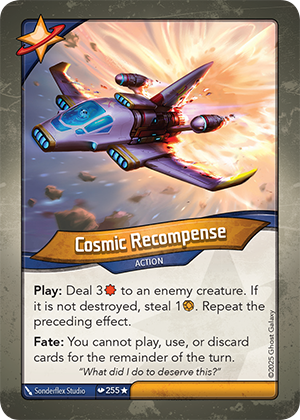
Hear me out—this card is actually very close to being reasonable (with today standard).
KeyForge has had time-walk effects before, or at least effects that come very close to skipping an opponent’s turn. The difference is that those cards always came with meaningful constraints: strict conditions, explicit downsides, or limitations that prevented a full turn skip.
I guess from Ghost Galaxy’s perspective, the prophecy requirement may have been intended as that condition. The problem is that prophecies are extremely easy to trigger, and when combined with the ability to resolve them off-house, this card becomes stronger than any previous time-walk effect the game has seen.
(And on top of that, it also has an additional powerful effect.)
My proposed solution is straightforward: introduce a real downside. A good reference point is Corner the Market. With or without a random house pip, it is one of the strongest effects ever printed, and it was only eclipsed by Ekwidon being an unreliable house in Æmber Skies. Cosmic—enabled by prophecy and effectively multi-house by nature—should be held to at least the same standard and carry a meaningful cost.
RAGE RESET / REITERATION


These two cards need to be discussed together, because taken as a pair, they turn Logos into the second most disruptive house in the game.
As with many of the problematic designs in Prophetic Visions, I believe their power is amplified primarily by the current state of the prophecy mechanic itself. If prophecy were meaningfully toned down, many of these cards would likely become far more reasonable, and these two may fall into that category. That said, discarding two random cards is already an extremely strong effect. Historically, very few cards have ever discarded two or more cards, and those that did always came with meaningful downsides.
Printing two separate cards with this effect—both of which can be executed off-house—is simply too much. I will be blunt: one of them would have been more than enough. Ghost Galaxy seems to have a recurring habit of fully committing to a mechanic once it is introduced. We saw this in Grim Reminders, where key cheat was pushed aggressively into the set, and we see it again here with disruption in PV. It feels less like careful iteration and more like an all-in approach.
This stands in stark contrast to the FFG era, where powerful cards typically excelled at one thing, or at most two. By comparison, designs like Geistoid in GR effectively compressed the roles of multiple cards into one—deck acceleration, recursion, æmber gain, æmber control, and creature control—all at once. That kind of design erodes house identity. Now, with PV, Logos is being pushed into the role traditionally occupied by Dis. At that point, it is fair to ask: what does house identity even mean anymore?
Returning to these two cards specifically, my recommendation is simple: keep one and remove the other. If a choice must be made, I would keep Reiteration. It is the more innovative design of the two, and discarding two cards at random is already powerful enough on its own. Well, perhaps this was also influenced by the fact that Logos is leaving the game permanently.
ATROCITY

Alright, I will admit I was wrong—this is yet another problematic card, and notably, one that is not even tied to the prophecy mechanic.
To be fair, it is not inherently broken, but I have a strong aversion to designs with extreme power disparity. Atrocity is exactly that kind of card: in some games it effectively wins on the spot, and in others it does almost nothing.
A small adjustment would already go a long way. Reducing its power to 2 would significantly lower its ceiling, especially in a set already saturated with protection effects. Simply making it weaker feels like a reasonable and sufficient approach.
HOODWINK AND OTHER AEMBER SWING CARDS

Cards like Hoodwink and other high æmber-swing effects are actually fine, in my view.
Yes, they are stronger than most of their predecessors, but they remain interactive. Opponents are given room to respond, and these effects are naturally vulnerable to scaling over time. That interaction matters.
The core problem—both in Grim Reminders and now in Prophetic Visions—is the lack of response windows. One of KeyForge’s defining strengths is that even though players act only on their own turns, the game still provides meaningful ways to respond to what the opponent is doing. That is precisely why key cheat effects were historically rare and came with significant downsides.
I struggle to understand why Ghost Galaxy chose to move away from that philosophy and push the game toward something closer to solitaire. If prophecy is toned down and disruptive fate effects are made less oppressive, then powerful but interactive cards like Hoodwink fit perfectly well within the game.

FINAL WORDS
There are a few other cards that could arguably be addressed as well, but once the prophecy mechanic itself is corrected, many of those cards become far more reasonable by default.
Ultimately, what I am trying to advocate for is a clear set of design principles:
Avoid non-interactive game states.
Avoid layered randomness created by disruptive effects.
Avoid single cards that are excessively powerful across multiple axes.
Avoid highly swingy designs where the ceiling wins the game outright and the floor does nothing.
Avoid extreme power disparity between cards and between houses.
Of course, this is not a complete solution. Any meaningful change still needs to go through careful playtesting—something that feels especially important given how delicate these mechanics are. But this at least outlines a direction: one that could turn Prophetic Visions into a fun and compelling experience, while still preserving what Ghost Galaxy originally set out to achieve.
In Vietnam, there is a saying: “Phòng bệnh hơn chữa bệnh”—prevention is better than cure. Admittedly, we are already late, and some damage has been done. Many of us are not as enthusiastic as we once were.
But we are still here.
So perhaps next year will be better—though, admittedly, that is something I have been telling myself every year since 2022.


Comments